

One Year Purchase Free
Just buy it.
“You deserve it,” says my inner voice after convincing myself that a day of bingeing Stranger Things has somehow earned me a reward.
This is just one more small purchase that will show up in my delivery box with that very familiar Prime logo, something that we’ve all grown to recognize. Those Prime boxes have recently piled up in our garage for several reasons: I like to shop for our daily necessities with the ease of single-click buying, and we used Amazon for our wedding registry.
Honestly, though, it’s too easy. We sling our data everywhere carelessly while, at the same time, every type of digital fraud is creeping. You name it, and there’s a data thief capitalizing on these easy experiences. Smishing is up by 700% (and that was 2021—let’s see what 2022 brings!), according to Proof Point. So that’s just text—that’s just ONE little point of data where thieves are trying to steal your digital fingerprint.
Security aside, there are all of the other downsides of shop till ya (virtually) drop. Money. Waste. Carbon footprint. Clutter. Duplicate items. And again—-money. For someone who has bought duplicate items more times than I care to share, hitting that “buy now” button a little slower may have helped me collect fewer tubes of toothpaste that simply pile up. The truth of that “buy now” button is worse than a few spare Tom’s Toothpastes. It adds up to blackout purchases, over-consuming, compromised data, and the endless cycle of buy-get targeted ads-buy more.
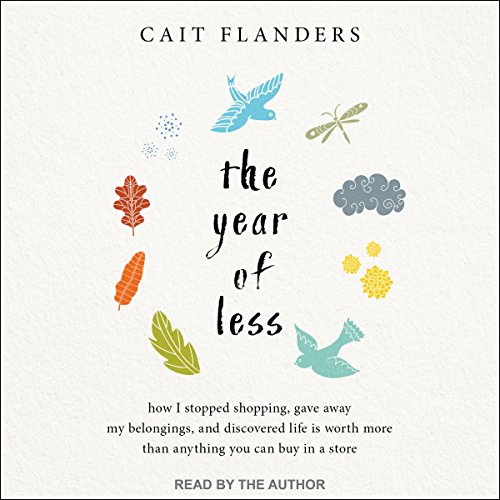
I recently listened to Cait Flanders’ book, “The Year of Less,” and realized that her 2-year experiment is exactly what I’d already started blueprinting in my head. Now it became clear I had to put this plan onto paper, in an Excel Spreadsheet, and then do the scariest part: declare it out loud, with purpose, and share it on Social Media so that I could be held accountable.
First, the why: bottom line, I spend too much and buy too much. I’ve been in the practice of wanting/needing something and simply buying. Being independent and, previously, before my husband showed me that men can indeed be capable providers, I was the breadwinner in almost all of my relationships. Responsible for myself and often my significant other, I blindly purchased the needs and wants of TWO people and carried more than my fair share.
Now, I have an incredible husband who is a minimalist and spends much less than me on consumables, clothes, toiletries, etc. Having spent a few months burning up the credit cards for services for our wedding, it became crystal clear that there are two truths to my shopping habits: I spend too much too often, and I buy things practically with my eyes closed, relying on the virtual wallet saved in these shopping carts and feeling numb to the reality of WHAT I’m buying and if I need it.
Honestly, the answer to: “do I need this?” is almost always a resounding “no.” I made exceptions and excuses during the months leading to our wedding because it felt like the right time to splurge, and it was. Our wedding was beautiful and warm and loving, and I laughed from morning until night. But usually, the type of excuses I made to purchase items for the wedding simply won’t fly in everyday life. And the damage from these habits has built a web of debt, complex and deep.
Spending less has to happen, no question, and I’m doing this. But then there’s a deeper scar than debt and spending, and that requires a little unpacking, too.
When a person grows up in a traumatic household, their relationship with money and material things are complicated. My mother, who I don’t write about often, vacillated wildly between blaming us for everything that went wrong in her life and telling us that she couldn’t wait to “disappear in the middle of the night, and maybe write you sometimes but never include a return address,” and the 180-degree apologies. The down cycles were accompanied by violence and hostility, and then on the flip side, when she regained composure, taking us on shopping trips to buy whatever our hearts desired to make up for her hysterics. We looked great, had the newest, most fashionable clothes and shoes, but wore them with great conflict.
No one knew what was going on behind the scenes, and we certainly didn’t tell. Our mother had told me once, when I was 11, “NEVER write about me, Amy.” Each time I try to tell the stories, especially in print, I break down and abandon the project. Those words struck a chord that played into a lifelong writer’s block about mothers, and those actions defined my relationship with shopping for the next decades of my life.
Putting an end to all of that means writing rules for myself. Ending excuses. Finding the real “why” to my shopping triggers—which are often the memories of our mother buying these things and being deep in debt but feeling like no one could see through the armor of a put-together outfit.
So here’s the process and rules:
- Declutter for quality. Get rid of everything that I have bought in an attempt to be something other than authentic. That beautiful blue pin-striped Boss suit? I promised myself I would wear it to executive functions and look my absolute best, or that someday when that big job opportunity came knocking, I would wear it to my interview, and somehow it would hide my insecurities and imposter syndrome. However, in the year since I snatched it up on sale at Macy’s, I have worn it zero times. Those executive functions and high-level recruiting just never happened. I won’t list here how many items I own that are in this category, but I will say that I have bags of things to sell or donate.
- Declutter for quantity. I own duplicate items, which I think we all do, but the point of decluttering all of those things is to inventory what I need/use/have and then put a stop to purchasing excess. In the decluttering phase, putting like item with like item and assigning a home to these things—I have noticed that if you don’t know where everything is, you often buy another to replace that “lost” item. Thus, I have hundreds of pens, over a dozen spatulas, eight (EIGHT!) whisks, and groceries stuffed into cabinets that have expired or that I purchased because I forgot or couldn’t find the original. Sauces and spices—I’m especially bad at.
- Implement the ban: technically, I’m already doing these things, but it really starts rolling when steps 1 and 2 have been completed. The ban is on:
- To-Go and Take-Out Coffee
- Clothes
- Shoes
- Bags and accessories
- Household decor like blankets, pillows, candles
- Makeup and toiletries except on a direct replacement basis when I run out
- Cleaning products except on a direct replacement basis when I run out, BUT I am attempting to make my own before I purchase
- Alcohol
- Look ahead and keep a list of things I’m allowed to purchase:
- Groceries
- Pet food and medical
- Direct replacement for a device or appliance, but only if it breaks and only if it’s not fixable
- Gas and vehicle maint including tires in the next 6 months
- Medicine (prescription and OTC on a direct replacement basis only)
- Spotify account
- Travel
This list will undoubtedly evolve as I go through this year, but I want the basic blueprint to remain. The point is to be more mindful, even with the “approved list.” For instance, I plan only to travel with money squirred aside from what I save based on the shopping ban itself.
It is an experiment, but I think it’s one that is long overdue and something I owe myself and my new little family. I know what needs to be done, and so it’s time—to just get to the doing.
https://share.libbyapp.com/title/3743177?fbclid=IwAR2eqiCwHrpScbRXi-yDkh3RKF0q8g1762ci50Tx1EPbFITDaQM_uKKTEvc
 Amy Liming
3 thoughts on “A Year Without”